
Also known as an “Abalakov”, v-threads were first used by ice climbers. With an ice screw, they could ‘drill’ two intersecting holes into the ice, creating a ‘V’ which could then be threaded with cord, making a rappel anchor that leaves very little gear behind.
Canyoners have begun to use the same concept, using a drill to make the V holes directly in the rock.
Why use v-threads?
V-threads have some unique advantages over traditional bolted anchors when the anchor location/canyon is exposed to severe floods, rockfall or avalanches.
For most bolt types, the bolt stud is permanently fixed into the rock. So if the stud gets bent, sheared off, or the thread is damaged, it becomes unsafe or unusable.
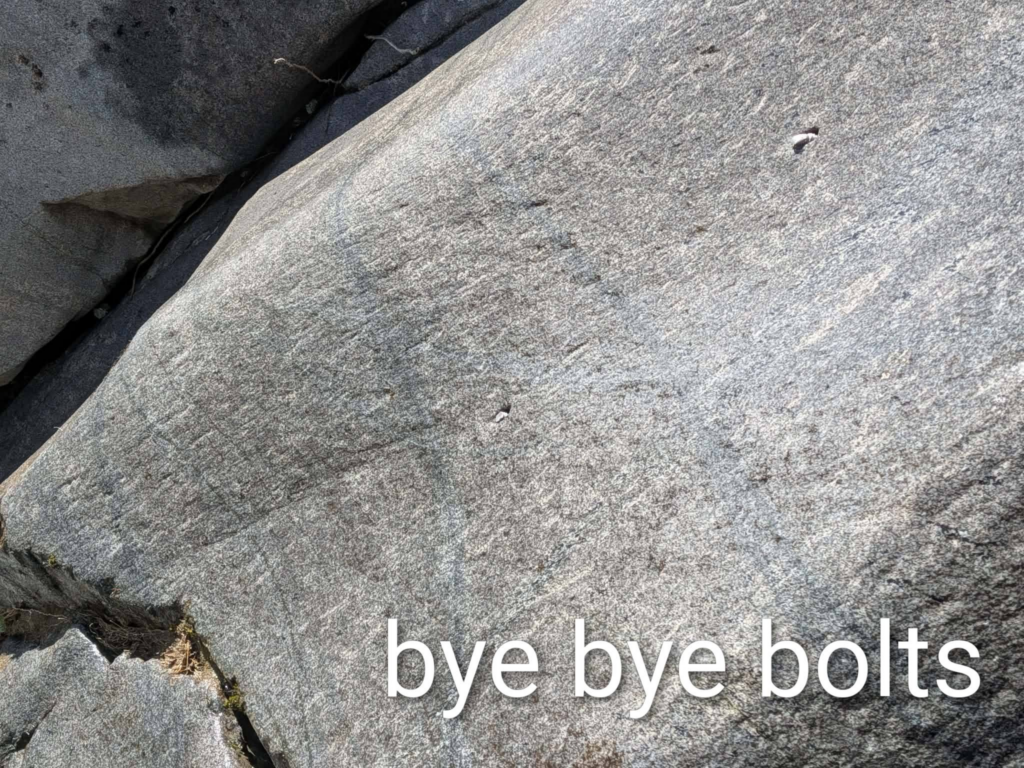
After such a catastrophic event, you’d better hope you’ve brought a drill and bolting gear if you’re the next team to visit that canyon….
To replace a destroyed bolt anchor, it requires forethought and possibly specialised tools (angle grinder).
The damaged bolt has to be cut off with an angle grinder or, if possible, hit with a hammer into the over-drilled hole. Then, a new hole has to be drilled, and another anchor installed. In many canyon situations, there’s a limited zone of rock where a suitable anchor can be placed, either considerign the quality of the rock, or the ideal/safe descent line for the pitch. Once a bolt is destroyed, the orphaned hole means that you cannot re-drill within a distance of 1.5x bolt lengths without compromising the strength of the rock.
However, with a V-thread, only the cord and maillion is exposed to the catastrophic event, and the rock face protects the holes, which are the structural part of the anchor.
Afterwards, the any team only needs to bring a replacement cord, maillions and a small hook / v-thread tool. There’s no need to carry a bolting kit or angle grinder.
Reasons against a using v-thread
Require more battery per anchor. Drilling 2x holes for a v-thread compared with a single hole. Also, 12mm holes make it easier to thread the cord than 10mm… Bigger diameter requries more battery power.
Replacement materials/tools required aren’t commonly carried. Which means there’s a risk that people won’t replace worn software frequently enough, or be able to re-rig a destroyed anchor. However, with education (and a clear note on any Topo) it shouldn’t take too much for people to get the skills and bring the gear.
Replacing v-threads usually requires 5mm Dyneema cord, which usually needs to be ordered from specialist stores. Triple Fishermans is the knot for this type and diameter of cord.
If the holes are known to be large diameter, 8mm nylon accessory cord could be used (which is easily available at most climbing shops)
A v-thread tool/hook, and a maillion is also needed.
Are v-threads strong?
Yep! But they are only as strong as the rock, so if the rock isn’t high-quality, then v-threads probably aren’t the answer…
Here’s a few resources to learn more about v-threads, including testing data, placement and more.
OTE Rescue.com – Rock Thread Testing 2021.
NZ Canyoning Association Bolting Code of Practice – page 27
HowNOT2 – video below…